
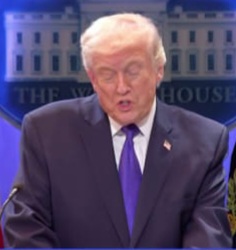
Undeterred by a major court defeat, US President Donald Trump on Friday unveiled a new 10 percent tariff on imports worldwide, invoking a separate trade law hours after the nation’s highest court struck down his earlier sweeping duties.
Announcing the decision at the White House, the president signed an executive order activating Section 122 of the Trade Act of 1974, a provision that allows temporary tariffs of up to 15 percent for 150 days to address balance-of-payments concerns.

Earlier in the day, the Supreme Court of the United States ruled in a 6–3 judgment that Trump had exceeded his authority under the International Emergency Economic Powers Act when he imposed wide-ranging “reciprocal” tariffs and country-specific duties.
Flanked by Solicitor General D. John Sauer, Commerce Secretary Howard Lutnick and Trade Representative Jamieson Greer, Trump insisted the ruling merely restricted one legal pathway and did not invalidate tariffs altogether.
Maintaining his tough trade posture, the president said existing measures introduced under Section 232 of the Trade Expansion Act of 1962 and Section 301 of the same 1974 statute would remain fully operational.
Signalling further action, he disclosed plans to initiate fresh investigations under Section 301 to address what he described as unfair trade practices by foreign nations, potentially paving the way for additional levies.
Responding to questions about consulting Congress, Trump argued that the authorities he invoked were already embedded in law and required no fresh legislative backing.
Addressing concerns over the estimated $175 billion generated from earlier tariffs, the president said the issue of refunds would likely be settled through prolonged litigation.
Expressing frustration with the court’s reasoning, he suggested the judgment created contradictions in trade enforcement powers, claiming broader embargo powers remain intact while narrower tariff tools were curtailed.
Explaining its stance, the Supreme Court majority concluded that the emergency law cited by the administration did not justify the scale of tariffs imposed, describing the action as beyond executive limits.
Observers note that while the ruling cancels a substantial portion of recent import duties, it leaves other statutory trade tools available, setting the stage for further legal and political battles over US tariff policy.
