
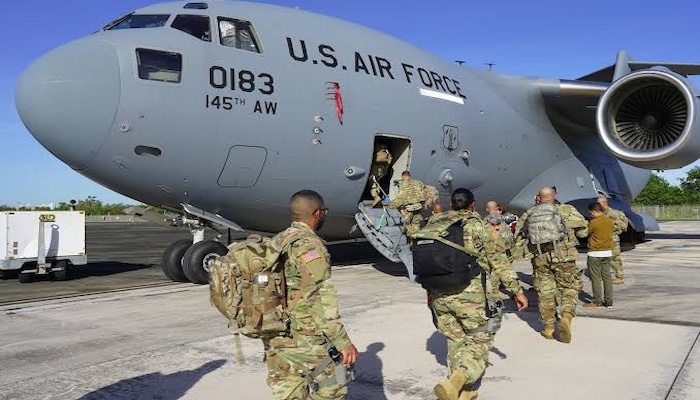
The United States has deployed about 200 military personnel to Nigeria to assist in training the country’s armed forces in the fight against Islamist insurgents, according to a report by The Wall Street Journal.
An American defence official confirmed that the move followed recent concerns expressed by US President Donald Trump over security challenges in Nigeria, particularly attacks affecting Christian communities.

According to the report, the troops are expected to enhance Nigeria’s counterterrorism operations by providing training and limited operational support to local forces.
Officials from both countries disclosed that the new deployment will complement a small team of US military advisers already working in Nigeria, mainly in intelligence support and target identification.
Providing further insight, the Commander of the United States Africa Command (AFRICOM), Gen. Dagvin R. Anderson, said during a virtual briefing that discussions with President Bola Tinubu had led to deeper cooperation between the two nations.
He explained that both sides agreed on the need for stronger collaboration to address security concerns in the region, leading to the introduction of a specialised US team to support ongoing Nigerian efforts.
Meanwhile, Nigeria’s Defence Headquarters clarified that the partnership with the United States is centred on capacity building and not direct combat engagement.
Military authorities stated that the cooperation includes professional training, intelligence sharing, logistics assistance, and strategic consultations aimed at tackling terrorism and other security threats.
In a statement, the Director of Defence Information, Maj.-Gen. Samaila Uba, stressed that all security engagements with the United States respect Nigeria’s sovereignty and are conducted within established bilateral agreements.
Separately, President Tinubu recently hosted a high-level US delegation at the State House in Abuja, led by Gen. Anderson and the Chargé d’Affaires of the US Embassy, Keith Heffern, where both sides discussed enhanced defence collaboration and regional stability.
The renewed US-Nigeria security engagement underscores growing international attention on Nigeria’s security challenges, while the emphasis on training and intelligence cooperation suggests a cautious approach that preserves national sovereignty.
