
By Samuel Sunday
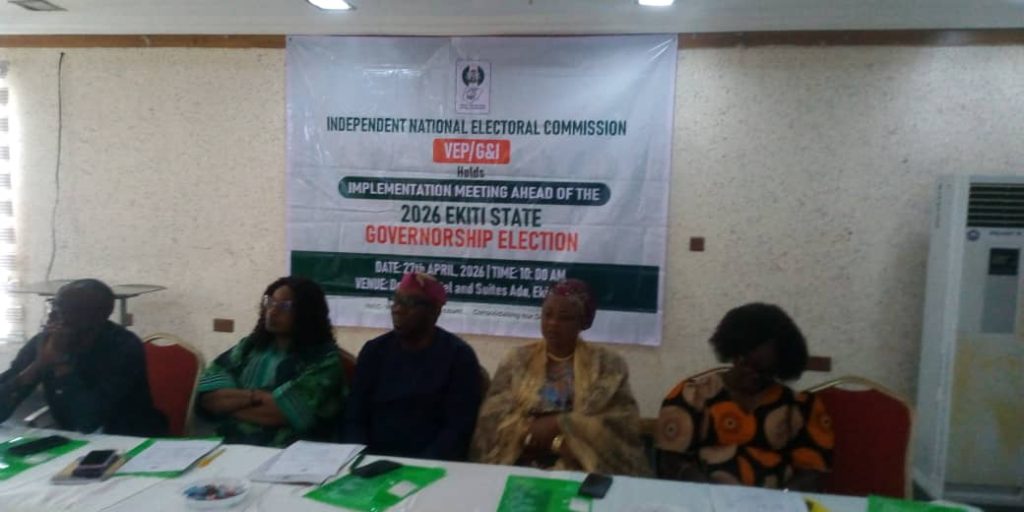
The Independent National Electoral Commission, INEC, Ekiti State, on Monday convened a voter education, publicity, and gender and inclusivity implementation meeting with stakeholders as part of preparations for the June 20, 2026 Ekiti State governorship election.

Addressing participants in Ado-Ekiti, the Resident Electoral Commissioner, REC, for Ekiti State, Hon. Bunmi Omoseyindemi, described voter education as “the backbone of any credible election” and called for stronger collaboration to ensure a free, fair, credible, inclusive, and peaceful poll.
“As we approach the election, our focus must be clear: we must ensure voters are well informed, counter misinformation and fake news, promote peaceful participation, and build public trust in the electoral process through our actions and through education,” Omoseyindemi said.
The REC stressed the need to intensify publicity so that key election information reaches rural communities, first-time voters, farm settlements, and residents in mountainous regions across all 16 local government areas of the state.
Reaffirming the Commission’s commitment to gender equality and inclusivity, Omoseyindemi stated that democracy can only be truly representative when no segment of society is left behind.
He called for deliberate efforts to ensure the full participation of women, persons with disabilities, PWDs, youths, and other marginalized groups, including accessible voting arrangements and youth mobilization against electoral violence.
He identified key Ekiti-specific concerns to be addressed, including misinformation and politically motivated narratives, vote-buying tendencies, security concerns in flashpoint areas, and voter apathy in some communities.
On the issue of low voter turnout, the REC said the national voter register, which has been in use since 2011, must be cleaned to remove duplicate and obsolete entries before turnout can be accurately assessed. He urged stakeholders to support the voter revalidation process.
“Effective voter education and inclusivity are shared responsibilities. INEC alone cannot achieve this without the support of stakeholders,” Omoseyindemi said.
“Your role in advocacy, community engagement, and information dissemination is critical to the success of this election. All of us must be involved in the democratic process. It is our responsibility.”
He urged stakeholders to move beyond office-based planning and engage directly with grassroots communities to understand their real needs and design voter education programmes that address those needs.
Also speaking, the INEC official in charge of Voter Education and Publicity, Mrs. Aribisala, said the meeting was jointly convened by the Voter Education and Publicity Department and the Gender and Inclusivity Department due to their shared responsibilities and target audiences.
She explained that the platform would enable both departments to align activities, harmonize implementation strategies, and ensure that timelines and expectations are clearly understood.
“Our shared objective is to deepen public awareness, encourage meaningful participation, and ensure that every community is reached through our various interventions to strengthen and consolidate our democracy,” she said.
Mrs. Aribisala noted the importance of working closely with the National Orientation Agency, NOA, a key member of the National Inter-Agency Advisory Committee on Voter Education and Publicity, NICVEC, as INEC prepares for local government-level engagements next week.
Director, Gender and Inclusivity, INEC Headquarters, Abuja, Mrs. Lakunaya Bello, called on electoral officers to pay attention to the distribution of assistive devices for persons with disabilities.
She urged civil society organisations to take voter education messages to the grassroots in languages and formats that marginalized voters can understand.
“Experiences from previous elections have shown that deliberate and sustained efforts are required to achieve meaningful inclusion,” Bello said.
“Barriers such as limited awareness, accessibility challenges, and sociocultural constraints must be addressed through proactive engagement and targeted interventions.”
She encouraged participants to propose practical solutions that will enhance inclusivity in the Ekiti State governorship election, ensuring the poll is not only free, fair, and credible, but also reflects the democratic values of participation, equity, and representation.
The meeting was attended by INEC staff from the 16 local government areas of Ekiti State, representatives of civil society organisations, the media, security agencies, and other election stakeholders.
