
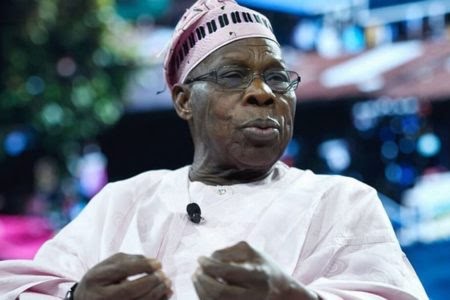
Former Nigerian leader, Olusegun Obasanjo, has dismissed rumours about his death, declaring that he remains strong and healthy despite being 89 years old.
Speaking on Wednesday in Abeokuta during a colloquium organised to mark his 89th birthday, the former president criticised individuals spreading a fake statement suggesting he had announced his own death.

Delivering a lecture titled “Burden and Blessing of Leadership: Reflections from Global Africa to the World,” Obasanjo said those behind the rumour were only wasting their time because he is still active and in good health.
The elder statesman, who was born on March 6, 1937, noted that reaching the age of 89 while still healthy convinced him that God had a purpose for keeping him alive.
According to him, those wishing him dead would be disappointed because he would remain alive and active for as long as his Creator desires.
He said some individuals recently circulated a false document in his name suggesting he was preparing for his death, adding that such claims do not reflect God’s plan for his life.
Obasanjo stated that God had assured him there were still important assignments for him on earth and had also provided him with the strength to continue serving humanity.
Beyond addressing the rumour, the former president also used the occasion to speak about the leadership challenges confronting Africa, which he said had slowed the continent’s development for many years.
He argued that Africa possesses enormous resources and potential but continues to struggle with poverty, conflict and insecurity largely because of poor leadership.
According to him, the continent’s problem is not a lack of natural endowment but the failure of many leaders to serve the interests of their people and strengthen democratic institutions.
Obasanjo warned that some political leaders begin their careers with promises of reform but later abandon those ideals once they assume power.
He added that such leaders often weaken democratic structures, silence critics and manipulate institutions to protect personal interests and those of their associates.
The former president emphasised the need to focus on leadership formation, stressing that societies must raise leaders with strong values rather than merely teaching leadership skills.
He also urged young Africans to take governance seriously and work towards building transparent and accountable democratic systems across the continent.
Reflecting on his own career, Obasanjo said leadership often comes with heavy responsibilities, including difficult decisions that could affect millions of lives.
He recalled his role during the closing stage of the Nigerian Civil War when he commanded the Third Marine Commando Division and had to make critical choices about military actions that could affect civilians.
The former president also spoke about the pressures he faced after becoming Nigeria’s civilian leader in 1999 when many citizens expected immediate solutions after years of military rule.
He explained that leadership requires courage to stand by principles even when such decisions are unpopular or costly.
Obasanjo further remembered his imprisonment under the late military ruler, Sani Abacha, noting that he spent about three and a half years in detention and narrowly escaped execution.
Despite the burdens of leadership, he said the role also offers opportunities to make meaningful contributions to society.
He cited achievements such as Nigeria’s successful negotiation for debt relief from the Paris Club and the establishment of the Economic and Financial Crimes Commission as some of the positive outcomes of his time in office.
Concluding his remarks, Obasanjo again dismissed the rumours about his death, insisting that he remains strong and ready to continue contributing to national and continental development.
