
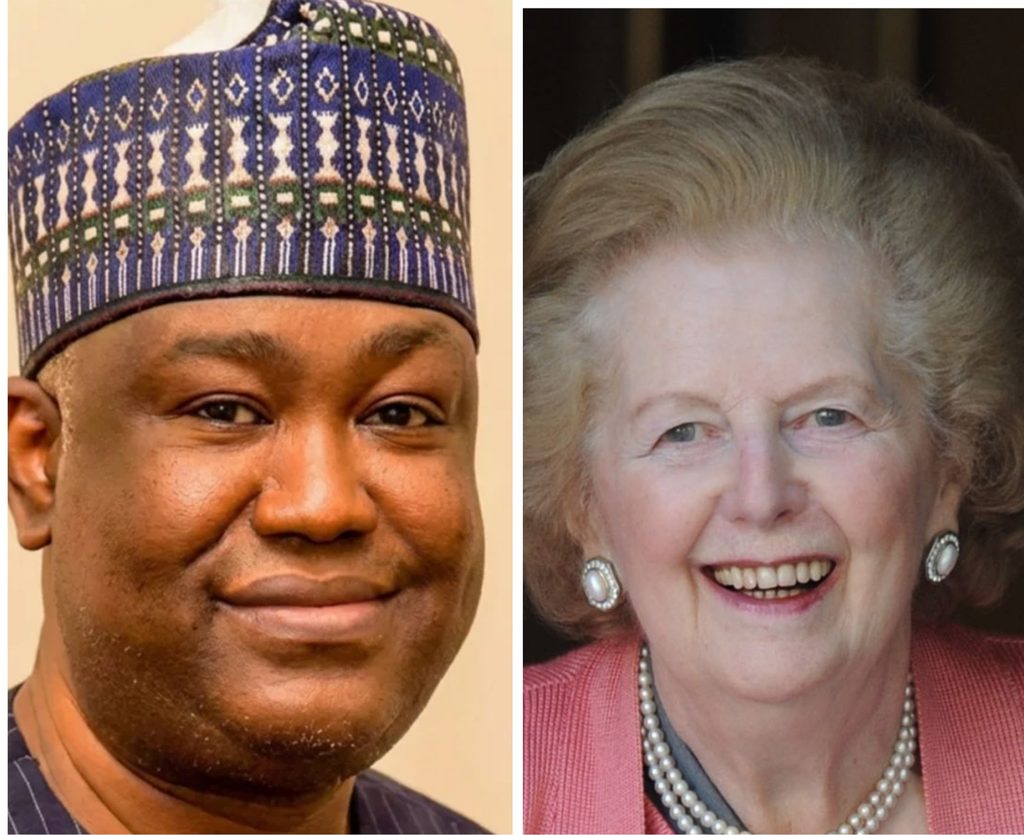
Accord Party Presidential candidate, Dr. Gbenga Olawepo-Hashim, has recounted how he and four fellow student activists confronted former British Prime Minister, Margaret Thatcher, at the Murtala Muhammed Airport, Lagos, in 1988 over her stance on apartheid in South Africa.
The incident, contained in an extract from his forthcoming autobiography, _Sunrise At Midnight_, details how Hashim and four other activists broke through a police cordon and advanced onto the airport tarmac during Thatcher’s visit to Nigeria, leading to their arrest.

According to the account, the confrontation occurred on January 7, 1988, at the height of global opposition to Thatcher’s position on economic sanctions against South Africa’s apartheid regime. Her visit to Nigeria had triggered protests by students, workers and anti-apartheid campaigners who believed Britain should exert stronger economic pressure to dismantle the racist system.
Thatcher had opposed punitive economic sanctions, arguing that it could worsen the hardship of black South Africans and damage the economies of neighbouring African countries. In her address at an official dinner in Lagos that evening, she maintained that destroying South Africa’s economy would not provide the best route to ending apartheid.
However, Nigerian activists considered her position inadequate in the face of racial oppression and denial of political rights to the black majority.
Hashim recalled that the protest started at the Nigeria Labour Congress secretariat on Olajuwon Street, Tejuosho, before demonstrators marched through Yaba and along Ikorodu Road towards Ikeja Airport, carrying placards and African National Congress (ANC) flags produced by the Nigeria-ANC Friendship and Cultural Association.
He put the number of protesters at about 2,500, with the procession stretching across a substantial part of Lagos and causing traffic gridlock, as they headed for the Protocol Gate of the airport to register their opposition.
The book noted that authorities had anticipated the demonstration and deployed police officers along the route and around the airport, prohibiting any mass rally at the airport and cordoning off the perimeter ahead of the British Prime Minister’s arrival.
But for Hashim and a small group of student activists, remaining behind the police line would have meant missing an opportunity to deliver their message directly.
When Thatcher’s aircraft landed at about 12:05 p.m., five student activists decided to breach the security cordon and move onto the tarmac to bring their placards and anti-apartheid message as close as possible to the visiting delegation, led on the Nigerian side by the then Deputy Head of State and Chief of General Staff, Vice Admiral Augustus Aikhomu.
Their sudden appearance on the tarmac, the book said, caused alarm among officials and security personnel, prompting the then Chief Press Secretary, Chief Duro Onabule, to shout, “See them!” followed by an order: “Arrest them!”
Within moments, the protest turned into an arrest operation. The five activists were identified as Odion Akhaine, Olaitan Oyerinde, Rotimi Ewebiyi, Chris Ayaeze and Hashim himself. They were taken to the Lagos Airport Police Station and detained in a small cell.
Contemporary reports confirm that protesters challenged the British Prime Minister over her position on apartheid during her January 1988 visit, although not every detail of the activists’ encounter on the tarmac is independently documented.
Hashim, in the book, described the incident as part of a wider history of student activism, human rights advocacy and resistance to authoritarian rule in Nigeria, noting that the protest was more than a demonstration against a visiting foreign leader.
According to him, it reflected the conviction among Nigerian anti-apartheid campaigners that the struggle against racial oppression in South Africa was a shared African responsibility, and that international leaders should be held accountable for the policies they pursued.
Nearly four decades later, the episode, as captured in _Sunrise At Midnight_, remains a defining moment in his early political life and a testimony to the role played by Nigerian students and labour activists in the international campaign against apartheid.
