
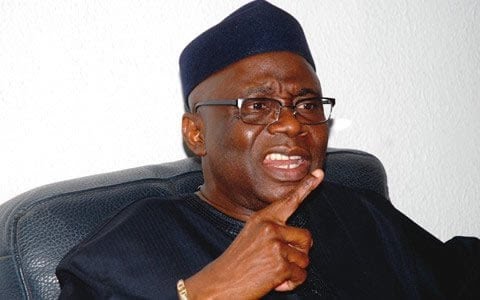
Fresh reactions have continued to trail the renewed comments of United States President Donald Trump on Nigeria, as the Serving Overseer of the Citadel Global Community Church, Pastor Tunde Bakare, says the American leader’s motive is strongly tied to Nigeria’s oil wealth, real estate space and emerging technology opportunities.
Bakare, who spoke during a State of the Nation Address in Lagos, said Trump’s recent description of Nigeria as a “Country of Particular Concern” and his remarks about Christian genocide were not just humanitarian concerns, but signals of deeper economic interest in the country. The cleric explained that Trump’s foreign policy often revolves around transactional deals, and Nigeria fits into several of his long-term economic targets.

Speaking further, the cleric recalled a vision he had shortly after Trump won the 2024 US election, where the American leader appeared in Lagos dressed in Middle Eastern attire. Bakare said the imagery pointed to geopolitical links between Nigeria, the Middle East and America’s hunt for strategic influence across oil, real estate and energy hubs. He warned that such symbolism could spark religious tensions if the issues are not carefully managed.
The pastor stressed that Trump’s approach to international diplomacy is usually driven by bargaining power. He urged the Federal Government to present a clear business plan that could open doors to American investment while protecting Nigeria’s strategic sectors like education, security, industrial growth and advanced technologies. He maintained that Nigeria must not wait for external pressure before shaping its engagement with Washington.
Bakare also used the platform to comment on rising insecurity across the country. He said the repeated killings and attacks in the Middle Belt, North-West and South-East reflect deep-rooted wounds that previous governments failed to address. According to him, communities in Benue, Plateau, Southern Kaduna and other parts of the Middle Belt have suffered targeted violence that should not be downplayed.
He said President Bola Tinubu faced a defining moment where he must choose between political calculations ahead of 2027 and the tougher path of tackling structural problems. While acknowledging recent recruitment drives and limited security emergencies declared by the government, he insisted that only bold reforms could stabilise the country.
As part of his recommendations, Bakare called for a Victims and Survivors Register, a national apology to communities ravaged by insecurity, and compensation plans to restore trust. He said the President must openly acknowledge government’s long-term failure to protect citizens as a first step towards genuine reconciliation.
He further urged the establishment of a Presidential Commission for National Reconciliation, Reintegration and Restructuring, saying the real problem confronting Nigeria is the unresolved “Nigeria Question” — identity, dignity, equity, coexistence and governance. He argued that no nation can grow on denial or half-truths.
The cleric also pushed for a restructured security architecture, including zonal and community policing, and the transformation of the federal police into a purely investigative agency. He proposed that each geopolitical zone should operate its own security council headed by governors on a rotational basis, feeding directly into the National Security Council.
Bakare added that the National Youth Service Corps should be upgraded into a two-year programme, with the first year dedicated to military training. He also suggested a dual foreign policy direction — a Trans-Saharan engagement with the Middle East and Arabian Peninsula, and a Trans-Atlantic alignment with Western nations.
He insisted that the combination of domestic reforms and a strategic international outlook would better position Nigeria to tackle insecurity, attract investment and stabilise its democracy.
