
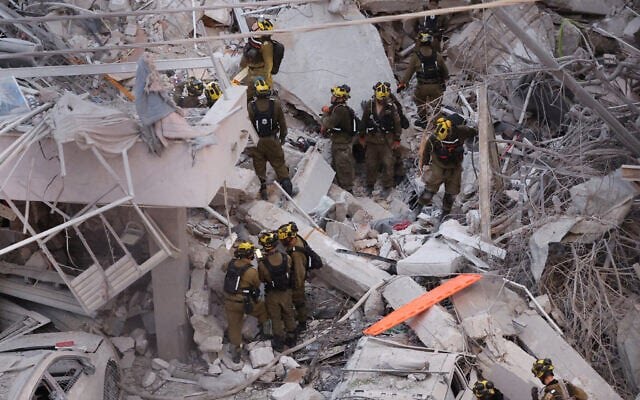
Iran, on Friday, launched a wave of ballistic missile attacks on various targets in Israel, including the Kirya area in Tel Aviv, which houses the Israeli Ministry of Defence and military command centre.
The attack came in response to Israel’s earlier airstrikes that reportedly killed top Iranian officials, including a high-ranking commander of the Islamic Revolutionary Guard Corps (IRGC), General Hossein Salami.

Iran’s counter-attack led to destruction in parts of central Israel and resulted in civilian casualties. This has raised fresh questions around the reliability of Israel’s celebrated air defence system, the Iron Dome.
The strikes reportedly followed Israel’s deep operations inside Iranian territory targeting military and nuclear assets with both jets and drones.
Below are key facts about the Iron Dome and why it may not have stopped all of Iran’s missiles:
Key Facts About the Iron Dome
- Backbone of Israel’s Defence The Iron Dome, locally called Kippat Barzel, is Israel’s main defence system against short-range rockets and missiles, especially from neighbouring regions.
- Detects and Intercepts Mid-Air The system uses radar to detect incoming threats. If a rocket is heading towards a populated or sensitive area, the system fires a Tamir missile to intercept it in the air before it lands.
- Introduced in 2011 The Iron Dome became operational in 2011 and has since seen several upgrades. Israeli defence officials claim it has successfully intercepted thousands of rockets over the years.
- Joint Israeli-U.S. Project It was developed by Rafael Advanced Defense Systems, an Israeli government-owned company, with strong financial and technical backing from the United States.
- Made Up of Several Units Israel is believed to have about 10 Iron Dome batteries spread across the country. Each battery can protect up to 60 square miles and has three to four launchers, each loaded with 20 Tamir interceptors.
- Selective Targeting The system is designed to conserve missiles by ignoring rockets that are likely to land in open or uninhabited areas.
Why the System May Have Failed This Time
- Overwhelmed by Multiple Missiles Experts say the Iron Dome is highly effective but not perfect. In what is called a “saturation attack,” many missiles are fired at once to overwhelm the system, making it difficult to intercept all of them.
- Attacks on Weak Coverage Zones Iran may have targeted areas with limited Iron Dome protection or weak radar performance, reducing the chances of interception.
- Use of Advanced Missiles Reports suggest that some of the missiles used by Iran may have had advanced features such as manoeuvrable warheads and better guidance, which make them harder for the Iron Dome to track and destroy.
While the Iron Dome remains a strong pillar of Israel’s air defence, recent events have shown that even the most advanced systems have their limits — especially when facing a large and coordinated missile attack.
