
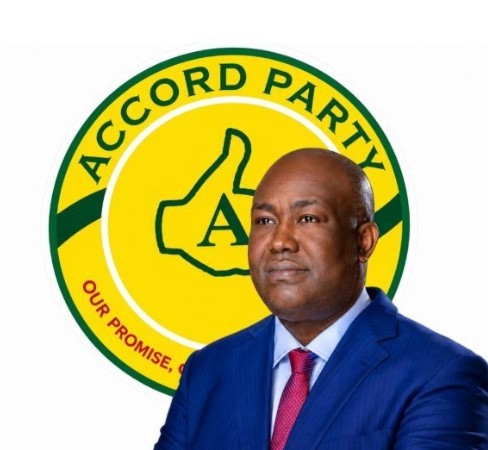
The defacement of campaign posters belonging to the Accord Party presidential candidate, Dr Gbenga Olawepo-Hashim, in Katsina has sparked concern among his supporters, who view the incident as an indication of rising political rivalry as the party intensifies its mobilisation in the North West ahead of the 2027 presidential election.
The posters, displayed as part of efforts to increase Hashim’s visibility in the state, were reportedly vandalised and deliberately defaced.

Although the identity and political affiliation of those responsible have not been established, the incident has fuelled speculation among supporters about possible political motives.
Some Accord supporters suspect that individuals sympathetic to either the ruling All Progressives Congress (APC) or the African Democratic Congress (ADC) may be behind the act. They argue that the growing visibility of Accord and its presidential candidate in the North West is introducing a new dimension to the political contest in a region where established parties have traditionally maintained strong structures.
The incident comes amid expanding grassroots mobilisation by Hashim’s supporters across Kano, Katsina, Kaduna and Jigawa, with particular focus on rural communities and areas described by campaign organisers as underserved.
The mobilisation is linked to an ambitious six million vote target announced by the Hashim Progressive Movement for the North West. The target covers the region’s seven states: Kano, Katsina, Kaduna, Jigawa, Kebbi, Sokoto and Zamfara.
The movement said it intends to build support through community-level engagement, coordination with political stakeholders and grassroots mobilisation, extending its activities beyond major towns and established political centres. In Kano, Hon. Bashir Miko and other leaders have also pledged to deliver two million votes for Hashim.
The campaign’s growing activity has also been accompanied by reports of political realignment in parts of the region. In June, media reports documented declarations of support for Hashim by former APC stakeholders and members in Kano, Jigawa and Katsina, who announced their defection to Accord during separate mobilisation meetings.
For Accord supporters, the Katsina incident underscores the need to protect democratic participation and allow political parties to campaign without intimidation or destruction of their materials.
It also raises questions about the atmosphere in which political mobilisation will take place as the 2027 election approaches.
With the North West emerging as a major focus of Hashim’s campaign strategy, the incident is likely to attract further attention to the political competition surrounding Accord’s efforts to establish a stronger presence across the region.
