
By Charles Ayodele
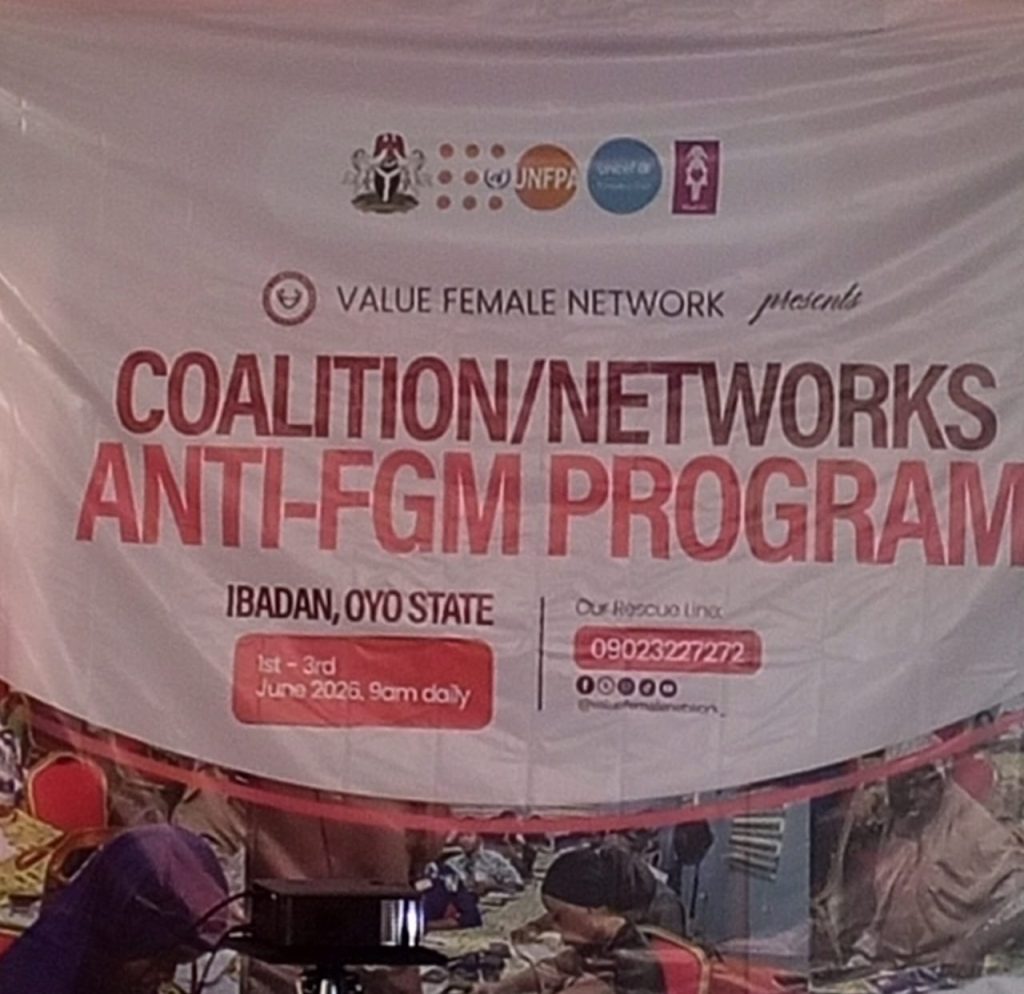
Stakeholders across Oyo State have renewed calls for stronger collaboration, sustained sensitization, and stricter enforcement of laws against Female Genital Mutilation, FGM, and other harmful traditional practices.

The call was made on Thursday at the close of a three-day capacity-building training in Ibadan organized by Value Female Network, VFN, with support from the United Nations Population Fund, UNFPA, and the United Nations Children’s Fund, UNICEF.
Participants included coalition networks, civil society organizations, community leaders, educators, gender advocates, and other stakeholders working to eliminate harmful practices.
VFN Executive Director, Dr. Costly Aderibigbe-Saba, urged participants to share lessons from the training with wider audiences through coalition groups, religious centers, and community platforms.
“The message must be passed to other coalition members and preached in religious houses and other environments to ensure effectiveness,” she said.
Declaring the workshop closed, VFN Senior Head of Programmes, Dr. Samuel Abimbade, said the intervention was designed to strengthen coalition networks, which he described as critical to eliminating harmful practices due to their extensive reach among diverse groups.
Abimbade said participants were trained on Comprehensive Life Skills Education, internationally recognized as Comprehensive Sexuality Education. The curriculum covered 10 modules aimed at improving knowledge, advocacy capacity, and community engagement skills.
“The campaign will not stop with this training. We will engage parents, teachers, in-school and out-of-school girls, as well as educators in formal and non-formal learning settings,” he said.
Abimbade stressed that harmful traditional practices cannot be eliminated through isolated interventions.
“Stakeholders must work together if we are to achieve lasting change and permanently end these practices,” he added.
Assistant Programmes and Communication Officer, Miss Hassanat Alao, emphasized the importance of practical communication and mobilization skills in driving behavioral change at the community level.
Legal practitioner and resource person, Godsgrace Osungboun, called for stronger enforcement of anti-FGM laws alongside intensified public awareness. Speaking on mental health and substance abuse, she urged governments at all levels to strengthen accountability measures against offenders.
“Government must continue to educate communities and ensure that anyone found violating the law is held accountable. Continuous advocacy remains critical where harmful practices persist,” Osungboun said.
Addressing participants virtually, UNFPA Gender and FGM Analyst, Mrs. Uzoma Ayodeji, highlighted the long-term physical, emotional, and psychological consequences of FGM on survivors.
Ayodeji reminded participants that FGM remains a criminal offense in Oyo State and warned that perpetrators are liable to prosecution under existing laws.
At the end of the programme, participants pledged to intensify anti-FGM advocacy across coalition networks and communities and expressed commitment to accelerating efforts toward the complete eradication of the practice.
Participants included representatives of the media, Red Cross, Girls Guide, Girls Brigade, Boys Scout, National Youth Council of Nigeria, Full Gospel Businessmen Fellowship, Hope for Tomorrow Youths, and Community Cadets. The organizations pledged continued collaboration in advancing campaigns against FGM and other harmful traditional practices.
