
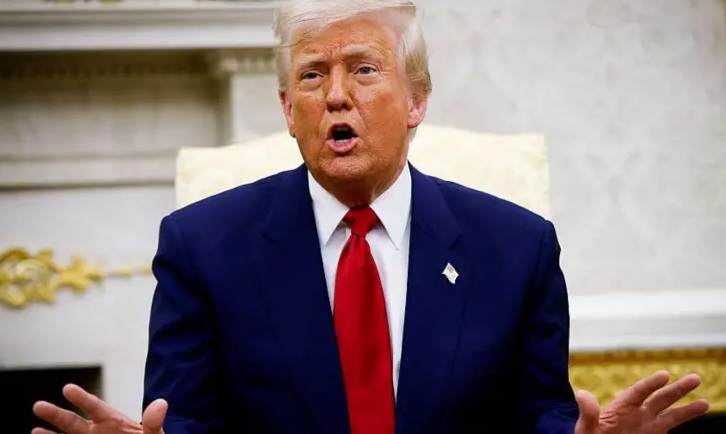
The administration of President Donald Trump has granted tariff exemptions on several consumer electronics, including smartphones, laptops and memory chips, offering major relief to American tech firms amid ongoing trade tensions with China.

The United States Customs and Border Protection announced the exemptions in a notice issued late Friday. The affected items are part of a broader tariff regime imposed just a week earlier by President Trump.
This move came as China enforced retaliatory tariffs of up to 125% on American imports on Saturday, with Beijing vowing not to bow to pressure from its largest trading partner.
Tech giants such as Apple, Dell, and Nvidia are among the key beneficiaries of the exemptions, as many of their high-end products are assembled in China. The exemptions are expected to reduce the impact of the 145% duties currently placed on Chinese goods entering the US.
According to data from US Customs, the exempted items represent over 20% of Chinese imports, a figure confirmed by senior RAND researcher, Gerard DiPippo.
Despite semiconductors being on the exemption list, President Trump hinted on Saturday that the component may still face new tariffs, possibly targeting global imports. He promised to give a “very specific” update on Monday.
The escalating trade war between the world’s two largest economies has raised concerns globally, with stock markets shaken, bond yields falling, and consumer confidence in the US sharply declining.
Some US billionaires — including allies of President Trump — have criticised the tariff strategy as harmful to the American economy and counterproductive in the long run.
‘Good News for Tech’
Commenting on the exemptions, Daniel Ives, a senior equity analyst at Wedbush Securities, described the announcement as “the best news possible” for tech investors.
He noted that the exclusions remove a major threat that could have severely slowed the growth of the American tech sector and affected development in areas like artificial intelligence.
While President Trump has insisted that tariffs will help revive domestic manufacturing, most of the exempted products, such as hard drives and processors, are currently not produced in the US.
White House Press Secretary Karoline Leavitt stated that companies like Apple and Nvidia are already “working hard” to shift production to the US. However, many experts believe it will take several years to build the necessary manufacturing capacity.
Prominent economist, Prof. Nouriel Roubini, criticised the administration’s policy direction, describing it as “incoherent and inconsistent,” warning that the exemptions alone won’t revive American tech production or reduce reliance on cheaper imports.
China Holds Its Ground
China, on its part, remains resolute in the face of US pressure. President Xi Jinping, in his first direct response, said the country was “not afraid” of the trade standoff.
Economists fear the continued disruptions in US-China trade — valued at around $500 billion — could raise prices for global consumers and possibly trigger a recession.
China’s Commerce Minister, Wang Wentao, told the head of the World Trade Organization (WTO), Dr. Ngozi Okonjo-Iweala, that the US tariffs pose serious threats to developing nations and have created instability globally and domestically in the US.
Meanwhile, the White House insists President Trump remains optimistic about reaching a deal with China but maintains that Beijing must make the next move.
