
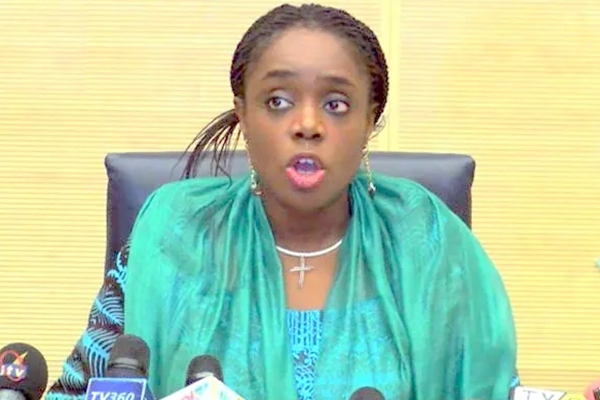
Former Minister of Finance, Kemi Adeosun, has said that ministers who served alongside her in government were fully aware that fuel subsidy was not beneficial to Nigeria and that it was unsustainable to continue funding it.
Adeosun made the disclosure on Friday while speaking on Inside Sources, a programme aired on Channels Television.

She said the Federal Executive Council at the time clearly understood that fuel subsidy was draining the country’s resources but lacked the political courage to completely remove it because of its impact on the masses.
“There was no minister who did not see that subsidy was killing us,” she said.
According to her, several measures were explored to curb the subsidy regime, including the introduction of the Subsidy Reinvestment and Empowerment Programme (SURE-P), but the government later discovered that subsidised fuel was being smuggled across Nigeria’s land borders to neighbouring countries.
She explained that Nigeria’s fuel price was about 44 per cent lower than prices in neighbouring countries, making large-scale smuggling inevitable.
“At some point, our daily fuel consumption figures rose to about 65 million litres. Nigeria had about 10 million vehicles at the time, so the figures simply did not add up,” she said.
Adeosun said investigations later revealed that Nigeria was effectively subsidising fuel consumption across West Africa, a burden the country could not sustain.
She added that funds spent on fuel subsidy denied the government the opportunity to invest adequately in critical sectors such as roads, education and healthcare.
“There was nothing to show for the fuel subsidy. Everybody knew that the policy had to go,” she said.
President Bola Tinubu had, in May 2023, announced the removal of fuel subsidy, citing the huge financial burden on the country. According to the Nigeria Extractive Industries Transparency Initiative (NEITI), Nigeria spent about $74 billion (₦112.94 trillion) on fuel subsidy between 2005 and 2021. Despite the official removal, the Nigerian National Petroleum Company Limited (NNPC) reported about ₦17.5 trillion in under-recovery and energy security-related costs by late 2024.
Adeosun stressed that with the removal of subsidy, government must ensure that the savings are channelled into projects that directly benefit Nigerians.
She urged citizens to closely scrutinise government budgets and demand accountability from their leaders.
“Now that the policy is gone, the question is how the savings are converted to help the people. Government has to do something structural, not just temporary palliatives,” she said.
She also called on Nigerians to be patient, noting that the long-term benefits of subsidy removal would outweigh the current challenges, especially with increased revenues going to the Federation Accounts Allocation Committee (FAAC).
On her resignation in 2018, Adeosun said the controversy surrounding her National Youth Service Corps (NYSC) certificate was used by her political opponents as an opportunity to force her out of office.
She disclosed that she informed former President Muhammadu Buhari of her decision to resign and her intention to go to court to clear her name.
“I had powerful enemies who saw an opportunity to get rid of me,” she said.
Adeosun explained that she chose to step down because it would be inappropriate to remain in the Federal Executive Council while pursuing legal action against the federal government.
“You can’t be suing the government and still be in the government. I believe I did the right thing,” she added.
