
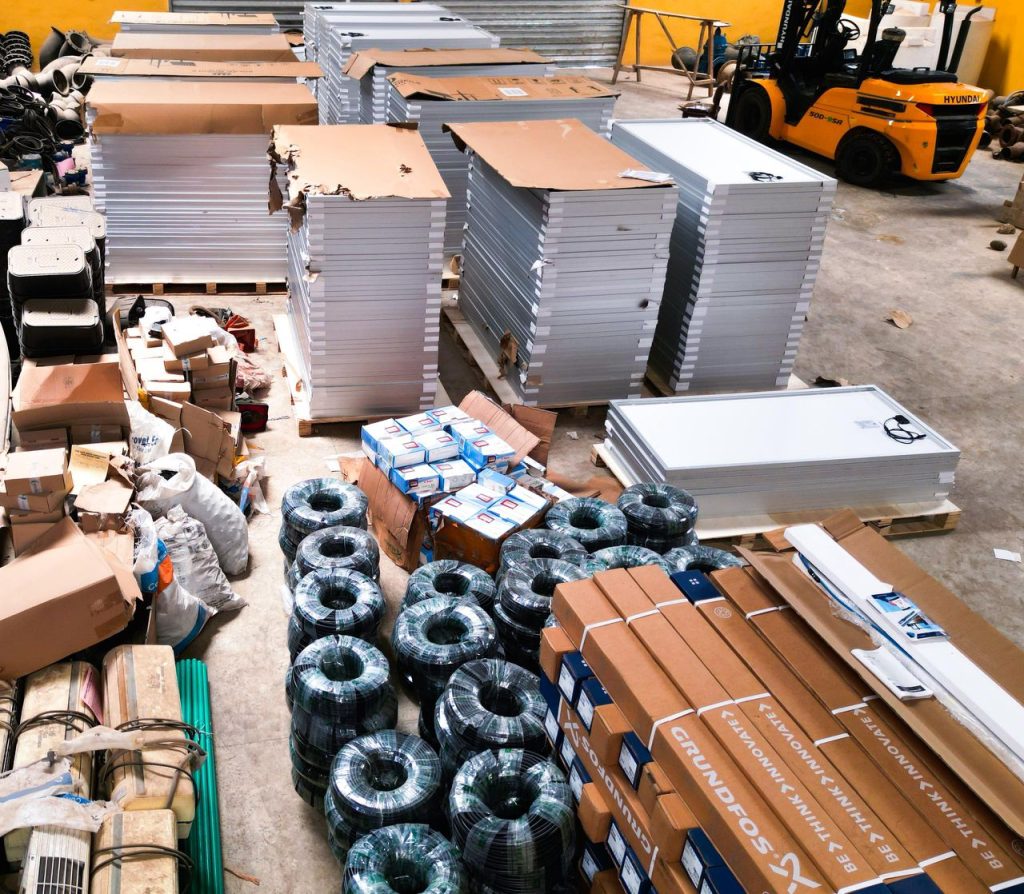
In a fresh move to boost access to clean water, sanitation and hygiene in communities, the Ekiti State Government has taken delivery of 110 solar-powered pumps and accessories for the construction of 110 new Water, Sanitation and Hygiene (WASH) facilities across all 16 Local Government Areas (LGAs) and 22 Local Council Development Areas (LCDAs) of the state.

The State Commissioner for Infrastructure and Public Utilities, Prof. Mobolaji Aluko, disclosed this in Ado-Ekiti while giving an update on the government’s water projects under the World Bank-supported Sustainable Urban and Rural Water Supply, Sanitation and Hygiene (SURWASH) programme.
Prof. Aluko explained that the SURWASH initiative, which has been ongoing for the past two years, is targeted at expanding access to water and sanitation services, especially in underserved rural and urban areas. He said the bulk purchase of the solar pumps was a deliberate move to reduce cost and ensure uniformity in quality and servicing.
According to him, “The broader project is our SURWASH program and part of what we have been doing in the past two years is actually to ensure access to water and sanitation in urban and rural areas.
“We have been constructing boreholes, sanitation and toilet facilities in schools, health centers and communities over the past two years with 121 Water, Sanitation and Hygiene (WASH) facilities rehabilitated and 64 solar powered boreholes constructed. The current installment is 110 WASH facilities consisting of anchored-in solar powered boreholes to be located in 55 schools and 55 health centers across the State with each LGA and LCDA getting two units, additional two units for each LGA and an extra two for Ado LGA.”
Prof. Aluko also spoke on efforts to address power challenges affecting water supply from dams, noting that the government is working towards establishing dedicated power sources to the state’s water facilities.
“Electricity for residential or commercial has far power less requirements than for dams because the dam requires heavy pumps, that’s why we need dedicated independent powers for our dams, and for agricultural irrigation purpose around the dams,” he said.
He added that the state has four main dams—Ero, Egbe, Ureje, and Itapaji—with a fifth, Ogbese Dam, owned by the Federal Government, currently being developed for multipurpose use including hydroelectric power.
Assuring residents of the government’s continued commitment to basic infrastructure development, the commissioner urged communities to take full ownership of public facilities in their areas to ensure proper maintenance and long-term sustainability.
