
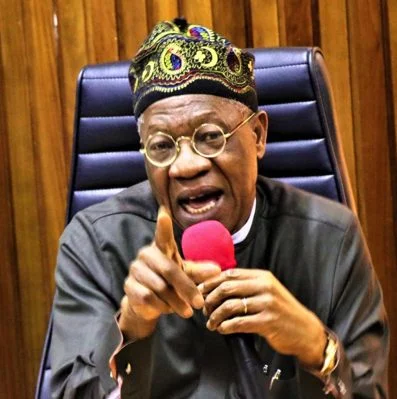
A former Minister of Information and Culture, Alhaji Lai Mohammed, has disclosed how a fellow cabinet member once criticised him at a Federal Executive Council (FEC) meeting, only for late President Muhammadu Buhari to firmly defend him.
The revelation is contained in Mohammed’s newly launched book, “Headlines and Soundbites: Media Moments that Defined an Administration,” which documents his experiences while serving in the Buhari administration.

In the book, the former minister explained that the criticism occurred while he was out of the country on official duty in the United States.
According to him, he was in Washington, D.C., attending his regular biannual engagements with international media organisations and think tanks when the incident happened.
He said he later learnt that a minister from the South-West region, whose name he withheld, accused him of incompetence and alleged that he was not doing enough to publicise the achievements of the administration.
However, Mohammed noted that President Buhari immediately rejected the allegation during the meeting.
He stated that the President told the council that he had been watching his media engagements on television and was satisfied with the way he was projecting the government’s achievements from abroad.
Mohammed described the President’s intervention as a strong show of confidence and support, adding that it amounted to a rare public endorsement from Buhari.
Reflecting further, the former minister said Buhari consistently defended him whenever the need arose throughout his tenure.
He also recounted another episode in which a petition alleging wrongdoing was written against him and forwarded to the President.
Narrating the incident, Mohammed said the President’s Aide-de-Camp later informed him that the petition had been submitted after persistent pressure from the petitioner.
According to him, Buhari reportedly dismissed the allegation at first sight, saying he did not believe it, but still ordered an investigation in line with due process.
Mohammed said the investigation eventually cleared him of all allegations.
The former minister added that, during his time in office, he could not recall any occasion when the President outrightly rejected his requests.
Nonetheless, he recalled an instance in 2018 that nearly led to such a rejection following a widely publicised open letter by former President Olusegun Obasanjo, which criticised the Buhari administration and urged him not to seek re-election.
Mohammed said Buhari initially directed that no government official should respond to the letter, out of respect for Obasanjo as a senior colleague in the military.
He explained that the President’s spokesman, Mr Femi Adesina, conveyed the directive and warned against any response that could be seen as disrespectful.
Despite the instruction, Mohammed said he later approached the President to argue that the government owed Nigerians an official response.
He revealed that the discussion was intense and nearly turned into a heated debate, an experience he said was unusual in his relationship with Buhari.
Eventually, he said the President reluctantly granted approval for a response, with a clear warning that Obasanjo must not be insulted.
Mohammed stated that he subsequently issued a detailed statement addressing the issues raised in the letter, while carefully observing the President’s directive.
He added that Buhari later commended him for handling the matter in a mature and professional manner.
According to him, several people later contacted the President to praise the response, describing it as well-articulated and responsible.
The former minister also recalled another incident involving a planned media tour to areas recovered from Boko Haram insurgents in 2015.
He said preparations were completed before the then Minister of Defence insisted that presidential approval was required because military assets would be deployed.
Mohammed explained that he quickly contacted the President’s Chief of Staff, who was able to reach Buhari in South Africa, where he was attending an international meeting.
He noted that the President granted immediate approval, even though the matter had not been discussed with him earlier.
Highlighting Buhari’s support further, Mohammed said the late President often approved special funding interventions to enable his ministry carry out key programmes, despite budgetary constraints.
He explained that the ministry’s allocation was inadequate for its wide responsibilities, making presidential interventions necessary.
Concluding, Mohammed said one enduring lesson from Buhari’s leadership was his quiet confidence in those he entrusted with responsibility.
He added that once the President gave an assignment, he allowed the official the freedom to act, believing that responsibility itself carried its own wisdom.
