
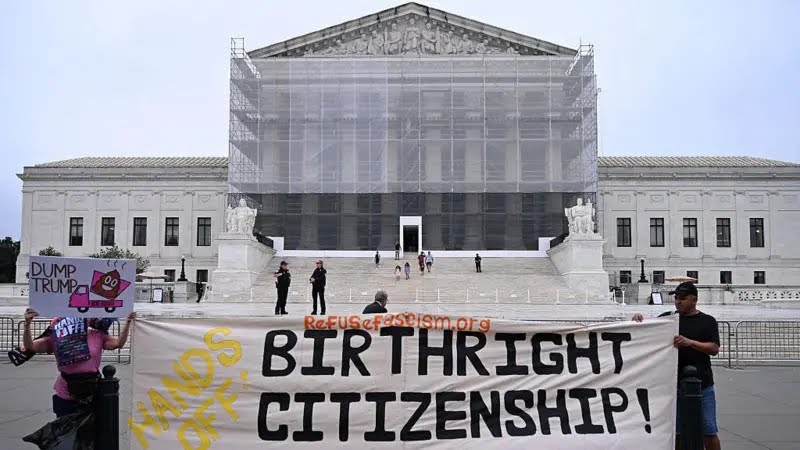
The United States Supreme Court has agreed to examine the legality of President Donald Trump’s attempt to halt automatic birthright citizenship for children born on American soil.
In a statement on Friday, the justices confirmed they would hear arguments in April, with a final ruling expected before the court rises in June.

Trump had, shortly after taking office, signed an executive order declaring that children born in the U.S. to undocumented immigrants or foreigners on temporary visas would no longer qualify for citizenship at birth.
His directive sought to reinterpret the 14th Amendment, which provides citizenship to all persons born or naturalized in the United States and “subject to the jurisdiction thereof.”
According to the former president, the measure was intended to curb illegal immigration and discourage “birth tourism,” where pregnant women travel to America to secure citizenship for their newborns.
Federal courts, however, blocked the policy almost immediately, ruling that it contradicts long-standing constitutional interpretation and an 1898 Supreme Court judgment that guarantees citizenship to nearly everyone born in the U.S.
Although lower courts halted the order, the Justice Department did not promptly ask the Supreme Court to reinstate it. Instead, it urged the court in March to use related litigation to limit judges’ ability to issue nationwide injunctions.
That request led to a June Supreme Court decision that restricted—but did not eliminate—the power of lower courts to issue such sweeping orders.
By September, the Trump administration returned to the Supreme Court, arguing that the policy aligns with the Constitution and urging the justices to rule in its favour.
Solicitor General D. John Sauer insisted that the 14th Amendment’s Citizenship Clause was never intended to cover the children of undocumented migrants or temporary visitors, saying, “The plain text of the Clause requires more than birth on U.S. soil alone.”
Opponents of the policy warned that the proposal would dismantle more than a century of established legal practice and questioned whether any president has the authority to determine citizenship status unilaterally.
Another concern is how the policy would function in practice, as birth certificates in the U.S. are issued by states and often do not record the citizenship status of parents.
Democrat-led states challenging the order told the court that the policy threatens to create uncertainty and undermine the core American principle of equality for all children born in the country.
While those states agreed that the Supreme Court should resolve the dispute, immigrant rights groups maintained that the law is too clear to warrant further review.
Trump’s executive order did not target individuals who already hold U.S. citizenship, but critics argued that the administration’s legal reasoning raises questions about the citizenship of anyone born in the U.S. to non-citizen parents.
