
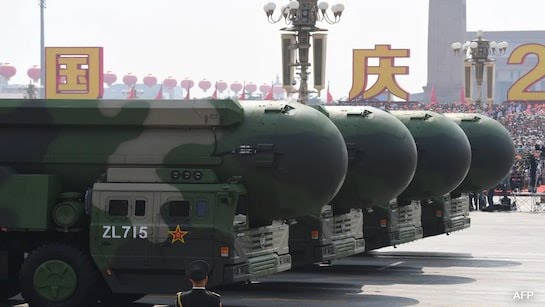
The United States on Monday accused China of rapidly expanding its nuclear arsenal and conducting secret low-yield nuclear tests, while urging that Beijing be included in any future arms control agreement.
Speaking at the Conference on Disarmament in Geneva, US Assistant Secretary of State for Arms Control and Nonproliferation, Christopher Yeaw, said the expiration of the New START earlier this month presents an opportunity to negotiate a “better agreement” that would include China.

New START, the last remaining nuclear arms treaty between the United States and Russia, expired on February 5. The agreement had limited both Washington and Moscow to 1,550 deployed nuclear warheads each.
Yeaw described the treaty as flawed, arguing it failed to address what he called China’s “unprecedented, deliberate, rapid and opaque” nuclear weapons expansion. He alleged that Beijing has massively increased its arsenal without transparency and could achieve parity with the United States and Russia within four to five years.
According to the Nobel Peace Prize-winning campaign group International Campaign to Abolish Nuclear Weapons, both Russia and the United States possess more than 5,000 nuclear weapons each. Washington claims China is fast approaching the limits previously imposed under New START and could have enough fissile material for over 1,000 warheads by 2030.
Allegations of Secret Nuclear Tests
The US also renewed claims that China conducted a low-yield underground nuclear test in June 2020 at Lop Nur in Xinjiang. Yeaw cited seismic data from Kazakhstan, alleging a 2.75-magnitude underground explosion consistent with a small nuclear detonation.
China has strongly denied the allegations, describing them as baseless and accusing Washington of using them as justification to resume its own nuclear testing.
The United States last conducted a nuclear test in 1992. Former President Donald Trump had previously indicated interest in resuming nuclear testing, though no formal decision has been announced.
A recent report by the Center for Strategic and International Studies said satellite imagery did not provide conclusive evidence of unusual activity at Lop Nur during the period in question.
