
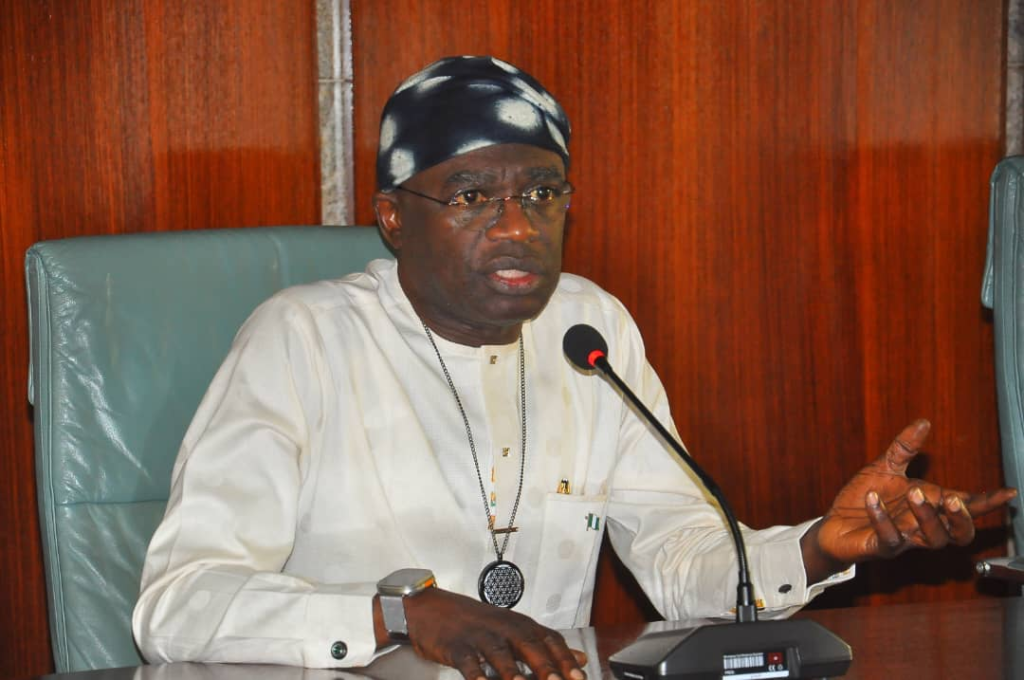
Benue State Governor, Rev. Fr. Hyacinth Alia, has downplayed widespread claims describing the state’s long-running security challenges as genocide, saying such assertions are inaccurate and not supported by international standards.
He made the clarification in Abuja during a consultative forum on the rights of Internally Displaced Persons (IDPs) and Forcibly Displaced Persons (FDPs), organised by the National Human Rights Commission (NHRC).

Alia, who is also a Catholic priest, said recent public narratives suggesting a genocidal situation in Benue were misleading. He stressed that the state’s security realities, though serious, do not fall under the United Nations’ definition of genocide.
“I am a Reverend Father, so being in governance does not take that away from me. In my state of Benue, we do not have any religious, ethnic, racial, national, or state genocide,” he said.
The governor acknowledged the many violent incidents communities have suffered over the years but argued that the crisis must be properly defined. According to him, understanding the roots of the problem is key to addressing it.
“Do we have insecurity in the state? Yes, we do. But it is not a genocide. One would need to go through the United Nations definitions for this,” he added.
Alia traced the conflict to the long-running clashes between agro-pastoralists and crop farmers, noting that what started as small disputes gradually expanded into a major security challenge.
“Have we lost people? Yes, at different stages. I’m giving a background of the challenges we’ve had for many years — talking about agro-pastoralists and typical farmers. It began like a minor issue and then grew to huge proportions. But that does not fit the parameters of a genocide,” he explained.
He cautioned politicians and stakeholders against mischaracterising the situation, warning that labelling it as genocide could fuel unnecessary tension and distort the actual dynamics of the conflict.
“For those who seek to politicise everything, there is no genocide in Benue State. But we do have security challenges,” Alia stated.
Authorities at the forum urged continued collaboration to protect the rights of affected persons and ensure that interventions remain rooted in facts rather than sensational claims.
