
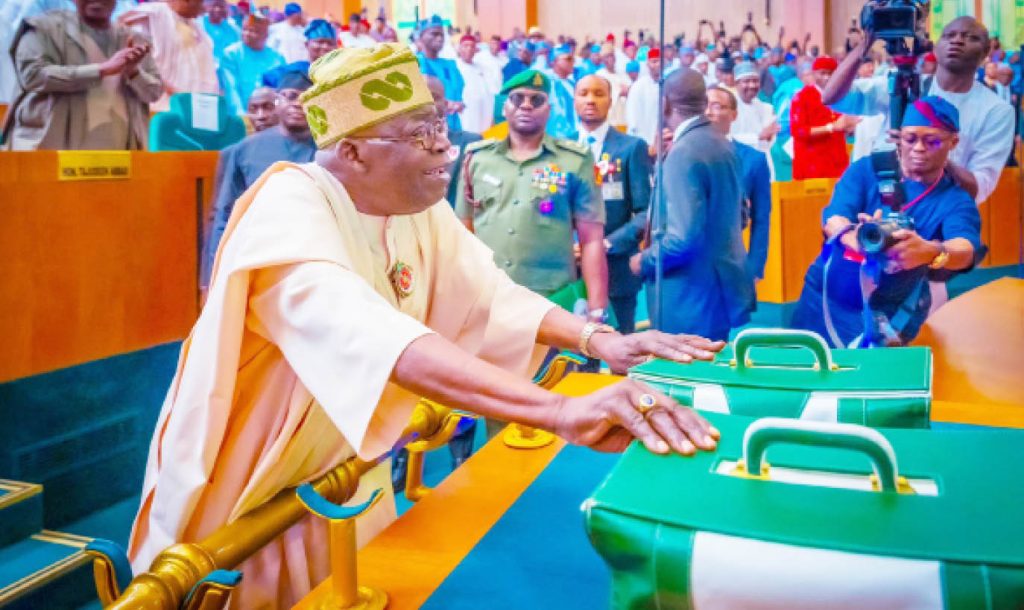
A civic-tech organisation advocating for budget transparency in Nigeria, BudgIT has revealed that the National Assembly inserted 11,122 projects into the 2025 national budget without clear justification.

These projects, valued at N6.93 trillion, account for 12.5% of the total N54.99 trillion budget signed into law by President Bola Ahmed Tinubu on February 28, 2025.
The findings were contained in an 18-page report released by BudgIT on Tuesday.
President Tinubu initially presented a budget proposal of N49.7 trillion to the National Assembly in December 2024, themed “Budget of Restoration: Securing Peace, Rebuilding Prosperity.”
The President later requested an upward review to N54.2 trillion, citing improved revenue from key agencies such as the Federal Inland Revenue Service, Nigeria Customs Service, and other government-owned enterprises.
The lawmakers further raised the budget to N54.99 trillion before passing it on February 13, 2025.
However, BudgIT’s analysis flagged several questionable insertions. Among them were:
238 projects valued above N5 billion each, totalling N2.29 trillion
984 projects worth N1.71 trillion
1,119 projects ranging between N500 million and N1 billion, totalling N641.38 billion
The report also noted that 3,573 projects worth N653.19 billion were tied to federal constituencies, while senatorial districts received 1,972 projects valued at N444.04 billion.
Some of the controversial items include 1,477 streetlight projects worth N393.29 billion, 538 borehole projects at N114.53 billion, and 2,122 ICT-related projects estimated at N505.79 billion. In addition, a sum of N6.74 billion was allocated for the empowerment of traditional rulers.
According to BudgIT, the Ministry of Agriculture was the hardest hit by these insertions, with 4,371 projects worth N1.72 trillion injected into its budget. This raised the ministry’s capital budget from N242.5 billion to N1.95 trillion. The Ministries of Science and Technology, and Budget and Economic Planning, were also affected, with inflated capital votes of N994.98 billion and N1.1 trillion respectively.
BudgIT further raised concerns that many Ministries, Departments, and Agencies (MDAs) were assigned projects outside their official responsibilities. For instance, the National Centre for Agricultural Mechanisation in Ilorin received N400 million for scholarships and N350 million for a health scheme in Bayelsa West Senatorial District—projects unrelated to its core mandate.
The group called on President Tinubu to provide stronger leadership in driving reforms to ensure that budget implementation is aligned with national development priorities.
“The current method where lawmakers inject projects into the budget without proper coordination undermines its credibility and effectiveness,” BudgIT said.
It also questioned the growing discrepancies in constituency project allocations, suggesting that actual figures may far exceed the unofficial estimates of N1 billion for senators and N2 billion for House members.
BudgIT concluded by urging the Federal Government to adopt transparent, data-driven budget practices and establish a mechanism to track and evaluate the impact of all constituency projects.
