
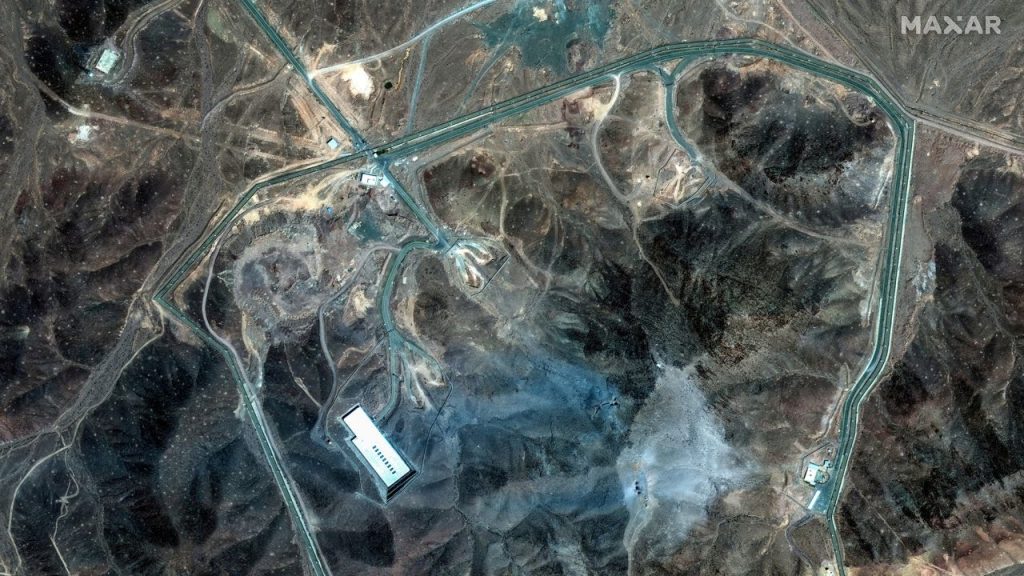
A preliminary intelligence assessment by the Pentagon has revealed that recent US airstrikes on Iran’s nuclear facilities failed to destroy the country’s nuclear programme and may have only delayed its progress by a few months.
According to CBS News, which cited sources familiar with the Defense Intelligence Agency’s findings, Iran’s stockpile of enriched uranium remains largely untouched, and key centrifuges at the targeted sites suffered only minimal damage.

The airstrikes, ordered by President Donald Trump, targeted three major nuclear facilities — Fordo, Natanz, and Isfahan — using advanced “bunker buster” bombs designed to penetrate deep underground. However, US military sources disclosed that most of the destruction was limited to above-ground structures, while the underground enrichment operations were largely preserved. Only a few entrances were sealed, and some infrastructure was damaged.
Despite the Pentagon’s internal findings, the White House has rejected the report. A spokesperson dismissed the assessment as the view of a “low-level loser in the intelligence community,” insisting the strikes were “completely successful.”
President Trump maintained that the sites were “completely destroyed,” and accused the media of attempting to downplay what he called “one of the most successful military strikes in history.”
Meanwhile, Democratic Congressman Brad Sherman expressed scepticism, questioning whether the strikes actually eliminated Iran’s capability to enrich uranium. He cited statements by officials and satellite imagery showing movements at some facilities before the bombing.
Reports also suggest Iran may have moved portions of its uranium stockpile prior to the attack. Iran has since downplayed the impact, with a senior official from the state broadcaster claiming that the materials were evacuated “well ahead of time.”
In contrast, US Defence Secretary Pete Hegseth insisted the airstrikes had “obliterated” Iran’s nuclear weapon capability. “Anyone who says otherwise is just trying to undermine the President and the mission,” he said.
Israel has also praised the operation. Prime Minister Benjamin Netanyahu declared that two existential threats — nuclear annihilation and missile attacks — had been neutralised.
However, international analysts remain divided. While satellite images show visible surface damage, experts say it is unclear how much underground infrastructure was actually hit. David Albright, head of the Institute for Science and International Security, noted that while the strikes caused serious disruption, Iran could eventually recover.
“Iran will need considerable time, effort, and resources to rebuild,” Albright stated, warning that the country is now under heavy surveillance and risks further attacks if it attempts to restore its programme.
In retaliation for the strikes, Iran fired missiles at the Al-Udeid Air Base in Qatar, which hosts US troops. The attack was largely intercepted and caused no casualties.
