
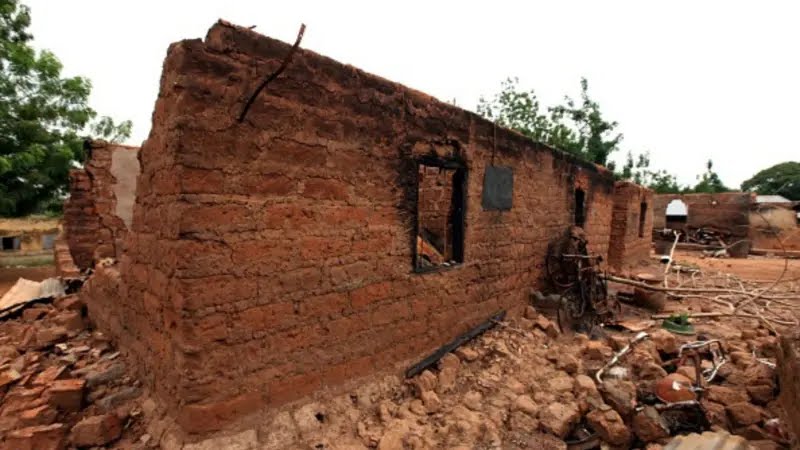
Fresh details have emerged on the deadly attack on Woro community in Kaiama Local Government Area of Kwara State, revealing that the mass killing was a carefully planned terrorist operation rather than a spontaneous act of violence.
Available security reports indicate that the assault, which claimed about 176 lives, followed repeated warnings about the gradual spread of jihadist groups into the North-Central region, warnings that were not effectively acted upon by security agencies.

Central to the attack is Abubakar Saidu, widely known as Sadiku, a long-time terrorist commander whose activities now stretch from the North-East to parts of the North-Central and North-West after more than a decade in the insurgency movement.
Investigations show that Sadiku began his rise around 2014 as a trusted aide of the late Boko Haram leader, Abubakar Shekau, before gradually carving out his own sphere of influence and emerging by 2026 as a dominant insurgent figure operating outside Boko Haram’s original strongholds.
Under sustained military pressure in the North-East, Sadiku is reported to have relocated his fighters westward, settling within forest belts across Niger and Kwara states, where his group began targeting farming communities, displacing residents and disrupting local economies.
Security assessments reveal that Sadiku was initially assigned by Boko Haram leadership to expand the group’s reach into Niger State, using alliances with bandit leaders and other extremist groups to secure arms, intelligence and safe havens.
At different times, he reportedly worked with bandit kingpin Dogo Gide and elements of the Darul Islam group, before internal disagreements led to violent fallouts and a shift toward a more ideologically driven campaign.
By mid-2025, Sadiku had reportedly established a major base inside the Kainji Forest Reserve, a development analysts describe as a strategic turning point that transformed the forest into a major terrorist corridor.
Spanning parts of Niger and Kwara states, the Kainji Forest Reserve has increasingly become a convergence zone for insurgents and armed groups, providing cover for recruitment, movement of weapons and attacks on rural settlements in Kwara, Niger, Kebbi and parts of Kaduna states.
Local security experts say this shift marks the expansion of Boko Haram-style violence beyond its traditional North-East base, aided by weak security presence, difficult terrain and porous borders.
Further intelligence links Sadiku’s faction to Jama’at Nusrat al-Islam wal-Muslimin (JNIM), an Al-Qaeda affiliate operating in the Sahel, with analysts pointing to overlapping areas of operation and possible cooperation around the Kainji axis.
Research findings suggest that fighters loyal to Sadiku have increasingly operated within territories influenced by JNIM since late 2025, with some attacks following similar patterns observed in parts of Niger State.
Reports also indicate that earlier armed groups in the area, such as the Mahmuda faction, lost control after the arrest of their leader, leading to defections, displacement of fighters and consolidation of extremist control under more violent splinter groups.
Evidence shows that Woro community received prior warning before the attack, as a letter written in Hausa and signed by Jama’atu Ahlis Sunna Lidda’adati wal-Jihad (JAS) was delivered to the village head weeks earlier, requesting a meeting and promising peace.
The community leadership reportedly forwarded the letter to traditional authorities and security agencies, but no preventive action followed.
On the day of the attack, eyewitnesses said gunmen arrived on motorcycles in the early evening, sealed off exit routes and launched coordinated assaults on homes and public spaces, including the emir’s palace, which was set ablaze.
Survivors said the attackers carried out systematic executions, using deception to lure residents out of hiding, before withdrawing into the forest in the early hours of the morning with abducted women and children.
Accounts from residents described the operation as highly organised, involving large numbers of fighters armed with automatic rifles and explosives, while the absence of immediate security response worsened the scale of casualties.
Community members said mass burials were ongoing, with many bodies still being recovered from nearby bushes, rivers and farmlands, while fear has forced most residents to flee their homes.
Economic activities in Woro and surrounding villages have since collapsed, as farmlands remain inaccessible and the presence of armed groups continues to threaten daily life.
The Woro massacre underscores a dangerous shift in Nigeria’s security challenge, showing how long-ignored warning signs, ungoverned forest spaces and fragmented responses are allowing terrorist networks to regroup and expand. Without decisive action to secure forest corridors, improve intelligence response and protect vulnerable rural communities, similar tragedies may continue to unfold across the North-Central region.
